Promote Marine Ecosystem Integrity
Healthy oceans support healthy communities. Our Ocean Recovery programme helps coastal communities protect and restore the ecosystems they depend on - from coral reefs and fisheries to sea-turtle habitats. Coral restoration is one of several workstreams within this programme, alongside fisheries and habitat management.
Environment Pillar
Strategic Plan 2020-25 | Pillar of Development
Sustainable Environmental Management
Assisting coastal communities in sustainable management of the environment based on which their livelihoods depend, including restoration of the coral reef fishery through coral gardens, and management of catchment to reef through implementing Joint and Co-Management Area plans (CMAP).
Coral Garden Programme
25,000+ corals restored across 39 hectares, transforming fishers into reef gardeners.
Catchment to Reef
Integrated ecosystem management from land through to marine protected areas.
Co-Management Plans
120 km² under Kenya's first officially endorsed Co-Management Area Plan (CMAP).
What We Do
Coral Restoration
Community-led reef restoration through 32 nursery tables, 457 artificial reefs, and 25,000+ corals planted since 2019.
Marine Sanctuary Management
Supporting 39 hectares of protected reef (Tengefu 30ha + Madowani 9ha) and Kenya's first 120 km² Co-Management Area.
Catchment to Reef Management
Integrated ecosystem approach from land to sea, including sea turtle conservation along 12 km of coastline.
How Coral Restoration Actually Works
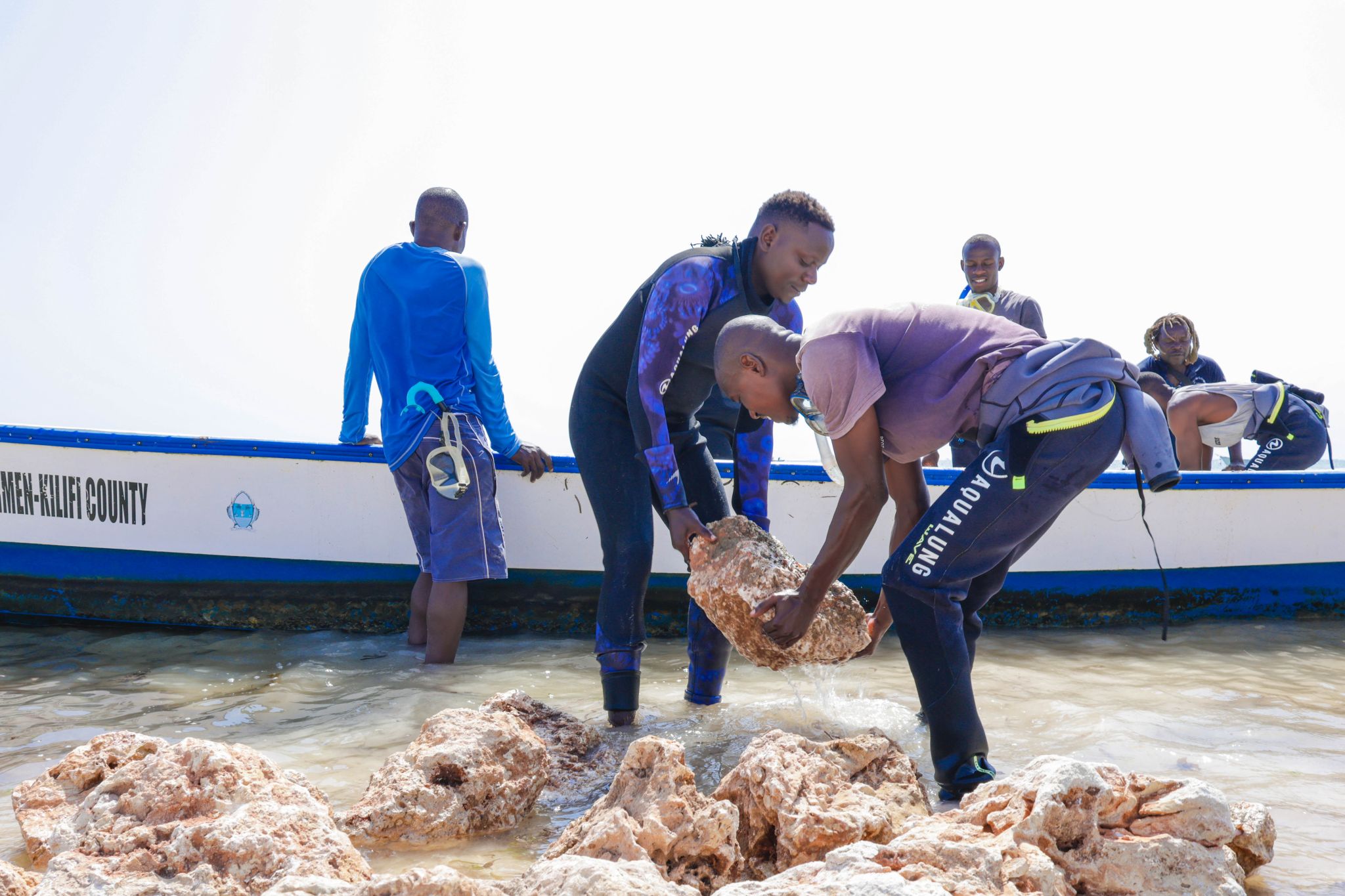
Since 2019, Oceans Alive has partnered with Coral Guardian International and Coral Reef Care to build Kenya's most active community-led coral nursery. But this isn't scientists doing the work - it's fishers. The same men and women who once extracted from the reef are now trained and employed as certified reef gardeners, maintaining 32 underwater nursery tables where coral fragments grow before being transplanted to 457 artificial reef structures.
The process is meticulous: coral fragments are carefully attached to nursery tables, monitored for growth, and once mature, transplanted onto degraded reef areas. The 85% survival rate proves the method works - but the real transformation is human, not ecological. Fishers who once saw coral as backdrop now understand it as the foundation of their livelihoods. They track growth rates, identify diseases, and protect restoration sites from damage.
This partnership model - international expertise meeting local stewardship - creates lasting change. Coral Guardian provides technical training and monitoring protocols. Coral Reef Care supplies materials and scientific guidance. Oceans Alive coordinates the community side. And the fishers? They own it. When external partners eventually leave, the reef gardeners remain. That's how 25,000+ corals across 39 hectares doesn't become a one-time project - it becomes a way of life.
The 30-Hectare Sanctuary That Changed Everything
The 30-hectare Tengefu sanctuary at Kuruwitu wasn't Kenya's largest protected area. But it was the most important, because it proved that community-led conservation works - not as a pilot, but as a model that could scale. Around 15 years of community management delivered measurable recovery, economic benefits for 300+ households, and a blueprint that reached national policy.
Kuruwitu Co-Management Area (Historic Milestone, 2022)
120 km² (12,000 hectares) under Kenya's first officially endorsed Co-Management Plan. Developed by the Kuruwitu BMU with Kenya Fisheries Service, Kilifi County Government, and Oceans Alive's technical support. This wasn't handed down - it was built from the ground up, complete with the first 6-step toolkit and Kenya's first IUCN SAGE analysis. Community passion met institutional backbone, and policy followed.
From Fishers to Reef Gardeners
Since 2019, Oceans Alive has partnered with Coral Guardian International and Coral Reef Care to build Kenya's most active community-led coral nursery at Kuruwitu. The same fishers whose livelihoods depend on the reef are now trained and employed as certified reef gardeners - planting, monitoring, and protecting the future they once took for granted.
39 hectares restored across Tengefu (30 ha) and Madowani (9 ha)
Protecting the Shoreline Guardians
Sea turtles return to the same beaches where they were born to lay their eggs. The Kuruwitu Turtle Group ensures they still have a safe place to come home to. Through marine patrols and nest monitoring along 12 km of coastline, the community protects both nesting mothers and hatchlings from poaching, predators, and habitat loss.
Kuruwitu Co-Management Area
Covering 12,000 hectares of ocean under Kenya's first officially endorsed Co-Management Plan (2022). Development of first 6-step toolkit and IUCN SAGE analysis, placing communities at the centre of marine governance.